
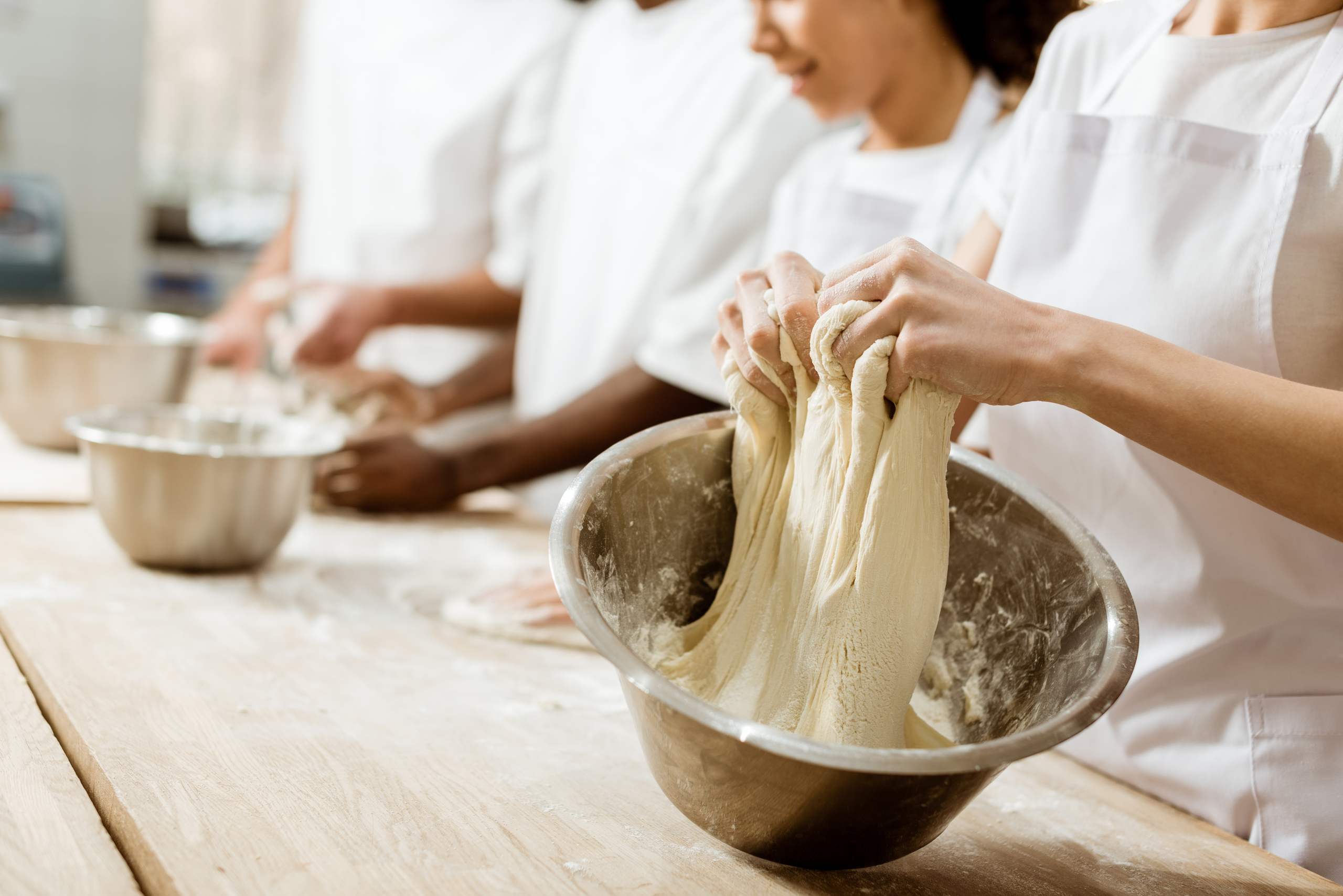
All bread baking comes down to the humble, seemingly simple mixture known as dough, which is really a complex, dynamic system. Understanding how the dough behaves and controlling all the stages of that system is the key to successful bread baking.
As the water touches the flour, proteins are beginning to form gluten. Other proteins called enzymes start to convert starches into sugars. This is not just simple mixing; this is where dough structure will start to form. Right now the dough consistency is inconsistent; however it will start becoming sticky and forming a structure as we work and rest it.
Working the dough (kneading) helps form a strong structure. As the dough is worked gluten forms an interlocking network that will hold the gas being generated during fermentation. This is what makes the dough able to hold it’s shape and be able to rise up properly in the oven. Without enough gluten the dough won’t be able to form the structure needed to hold it’s shape and we’ll end up with very flat loaves and bread. Working the dough too much can damage its structure and take away its elasticity so it’s important to balance it properly.
The resting period of the dough is also important to develop the dough structure. This is where the dough will relax and continue to build structure as gluten can continue to interlock during the rest. Fermentation has begun. Yeast consumes sugars and creates carbon dioxide that starts to form air pockets inside the dough to inflate it. Fermentation is an important part of bread baking, both in terms of creating volume for the bread as well as the flavor. We control the timing and temperature to achieve the correct fermentation.
Hydration (the amount of water in the mix relative to flour) also plays an important part in dough development. As we discussed in part 2, higher hydration doughs tend to yield an open texture while doughs with less water produce denser texture. A good baker will know that changing the level of hydration to the recipe can change the outcome dramatically.
Fermentation continues to develop the structure and flavor. As fermentation continues, the starches are being broken down further by the enzymes helping to further build flavor and aroma. This is why we use longer fermentation methods for artisan breads. The longer fermentation times let the natural processes work to develop the bread. No other additives are necessary.
Ultimately the dough is much more than a mixture it’s a living system. As you learned in this series, dough starts as a simple combination of water and flour and continues to develop structure and flavor the longer you wait. It develops over time and every action you take influences it’s future behavior. Learning to understand the dough is the key difference between amateur bakers and professional bakers. LoafBakePro’s goal is to help anyone learn to understand the dough and turn it into actionable steps you can take in your kitchen.